
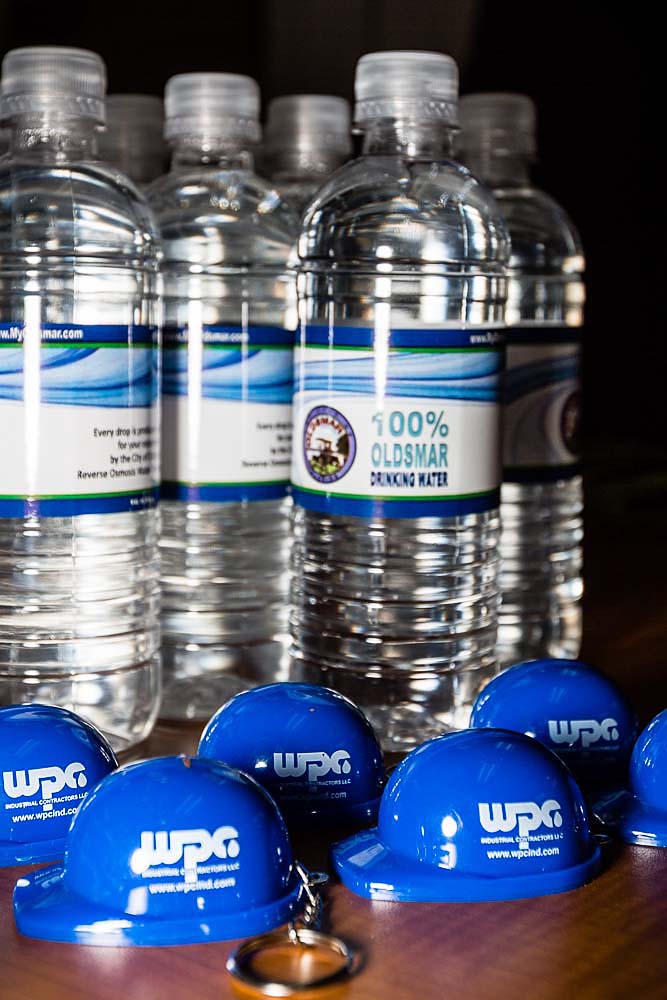
Oldsmar’s water treatment plant now produces 100 percent of the city’s drinking water.
Article published in The Palm Harbor Beacon, April 2013
By KERRY SCHOFIELD
PALM HARBOR – The city of Oldsmar joined a growing trend grown in January when it opened a new $20 million reverse osmosis water treatment plant.
The state-of-the-art facility provides water for about 15,000 residents and is designed to control water rates, while reducing hardness.
“Because we’re using membrane treatment, it removes a lot of the minerals,” said Johna Jahn, Department of Public Works utilities administrator. “Many people in the city had water softeners before because of the minerals in the old source water. We’re producing much softer water now. So many folks do not need to use their water softeners anymore.”
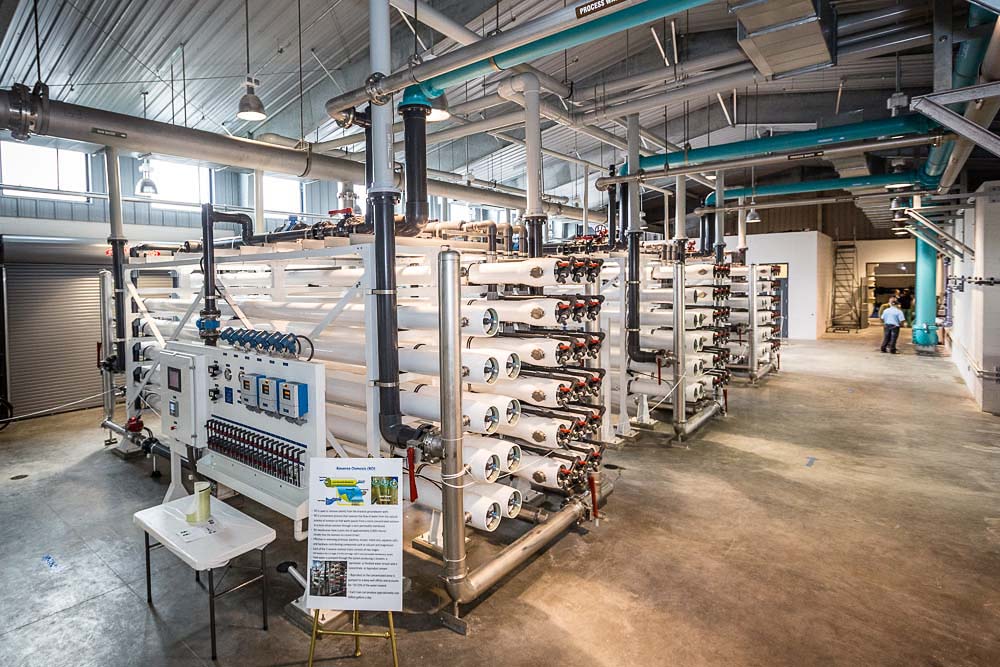
Inside Oldsmar’s new $20 million water treatment plant, a reverse osmosis membrane consists of skids containing tubes and individual membranes to filter brackish groundwater into high quality drinking water.
Residents who soften their tap water are advised to consult with a water treatment specialist to adjust their water devices.
The plant uses reverse osmosis membranes to remove salt, hydrogen sulfide and other contaminants from the water. The system is fully automated by a computer control system.
Continuous data is monitored including flow rates and pressures. Water quality is collected and evaluated by five licensed operators who staff the facility 24/7 on a rotating schedule. Due to the efficiency of facility systems, one site operator can physically maintain the plant at any given time.
Osmosis is a natural water quality in which non-salty water molecules move toward salty water. The reverse osmosis membranes are the robots of the treatment system removing nearly all dissolved and particulate materials from the water. The reverse osmosis membrane is housed inside a pressure vessel.
Brackish (salty) well water is forced through the membrane and the clean, desalted water is collected in a middle exit tube within the membrane. The well water passes through two membrane stages, removing 100 percent of the salt.
A ratio of 25 percent well water is lost during the reverse osmosis process resulting in 75 percent clean water. For example, about 750,000 gallons of clean water is produced for every 1 million gallons of well water.
A disinfectant, sodium hypochlorite (chlorine), and fluoride are added to the treated water, which is pumped to the city’s residents through a distribution system. The remaining 25 percent of wastewater is pumped into two separate 1,000-foot deep saline injection sites in the area.
“The receiving injection well has to be at the same salinity or higher, so we’re not contaminating anything in the ground,” Jahn said. “Sometimes it’s a misconception that people hear we’re injecting a waste – it’s really just concentrated salt water.”
Jahn said water rates will not be affected as a result of the project. Residential water rates inside the city for the first 1,000 gallons are $12.25 per month and rise incrementally thereafter. Costs for the same amount outside the city are $15.31.
Prior to the opening of the new plant, the city purchased drinking water from Pinellas County through a consecutive system. The Pinellas County pipeline is still maintained for emergency backup. The water treatment facility now provides up to 2 million gallons of water per day (MGD). The city’s average daily demand is 1.2 MGD. The plant design allows for adding an additional 1 MGD.
“We have more control over the quality and cost of water now that it’s our own,” Jahn said. “Reverse osmosis is the way of the future and this is where all the utilities are going.”
The Florida Water Management District contributed 50 percent of funding toward remediation facilities cost, which came in under budget.
“They encourage these types of projects because you are using an alternative water supply because it’s brackish – you wouldn’t use that for irrigation – and you’re not competing for other sources of water,” Jahn said.
The price tag included building pipeline needed to transport the reject water to two underground wastewater injection sites and pipeline for a labyrinth of 11 secured brackish supply wells, which are located in surrounding wetlands within a 1- to 2-mile radius of the plant.
The front of the water treatment building complements the neighborhood and is safeguarded by a 12-foot chain link fence with secured access. The plant resembles a large firehouse with a row of tall commercial garage doors.
The aeration and degasification towers are placed at the back of the plant. Biological scrubbers remove hydrogen sulfide, a poisonous gas that has the odor of rotten eggs. Two 1-million gallon water storage and distribution towers are located nearby.
For more information, visit http://www.myoldsmar.com.

 Kerry Louise Schofield
Leave a comment